
Table of Contents
- Why a Theological Curriculum Choice Matters More in a Small Church
- Start With Your People: Sizing the Curriculum to Your Congregation
- How to Evaluate a Theology Course Before You Buy
- Doctrinal Alignment and Denominational Fit
- Budget, Licensing and the Real Cost of a Curriculum
- Bible Study Curriculum for Small Groups vs Formal Theology Training
- Theology Training for Pastors and Lay Leaders in a Small Church
- Rolling It Out: Teacher Preparation, Lesson Planning and Review
- Frequently Asked Questions
Last Updated: October 18, 2026
Why a Theological Curriculum Choice Matters More in a Small Church
Choosing a theological curriculum for small churches decides what your people will believe, teach and pass on for the next decade.
Small congregations carry a heavy load with few people.
Most guides miss this: the decision is not mainly about content quality but fit. A brilliant theology course needing a trained lecturer and weekly marking will collapse in a church of 40.
Start With Your People: Sizing the Curriculum to Your Congregation
Match the curriculum to the people you have, not the number you hope to have. A church of 30 with two willing teachers needs a different product from a church of 150 with a staff minister.
Ask three questions before you look at any catalogue:
- Who will teach it, and what training do they already have?
- How many hours per week can learners realistically give?
- Will groups meet together, or will people study alone?
Small churches often run mixed-age groups, and a course written for a single age band will frustrate half the room. Look for flexible session plans, or plan to split into two tracks.
Write down your real teaching capacity before you shop. If you have one volunteer who can prepare for 90 minutes a week, that is your limit. Courses that need more preparation than that will quietly stop running by week six.
How to Evaluate a Theology Course Before You Buy
Evaluating a theology course means testing it against your teachers, your learners and your doctrine, in that order. Most churches do this backwards: they read the marketing page, get excited, and discover the problems in week three.
Request a sample lesson and a scope-and-sequence document, then read the sample as the volunteer teaching it. Could you prepare that session in the time you actually have?
The Five Questions That Filter Out Weak Courses
Run every candidate course through these five filters:
- Is the scope clear? You should see a full list of subjects and the order they are taught.
- Does each session have a teacher-ready plan? Look for aims, key passages, discussion questions and a clear takeaway.
- Is assessment realistic? A short quiz or reflection question works in a small group. Weekly essays do not.
- Can it flex across ages? Check whether the publisher offers adaptations or expects one lesson for everyone.
- Is the licence workable? Confirm how many copies you may print and whether you can reuse material next year.
Any course that fails two or more of these is a poor fit for a small church, however good the content.
Doctrinal Alignment and Denominational Fit
Doctrinal alignment is the degree to which a course matches what your church actually believes and teaches.
Read the statement of faith first, then two or three lessons closely. Publishers vary in how much they state plainly and how much they leave to the teacher.
Watch for these pressure points:
- Views on the Holy Spirit and spiritual gifts
- Baptism and church membership
- Women in ministry and church leadership
Where your church holds a firm position, choose material that shares it rather than material you must correct each week.
Do not assume a well-known publisher matches your doctrine. Reputable names cover many positions. A course that clashes with your church’s teaching will create friction with parents and elders long before it creates growth.
Budget, Licensing and the Real Cost of a Curriculum
The purchase price is only part of the cost, and in a small church the hidden costs kill programs. Budget for printing, teacher guides, training time and volunteer hours, then add the cost of replacing a curriculum that quietly stops running in term two.
Licensing is where small churches get caught: some materials are sold per learner, some per class, some per church. Ask the publisher:
- How many copies may we print for one group?
- Can we reuse the material with a new group next year?
- Is there a separate fee to show video sessions?
A cheaper course with tight printing limits can cost more than a flexible one. Build a total-cost estimate before you commit, and compare it against what your church can sustain for at least three years.
A Three-Year Total-Cost Worksheet
Use this structure to compare two or three candidates side by side, filled in with quotes from the publisher, not brochure prices.
| Cost line | What to record | Why it matters in a small church |
|---|---|---|
| Licence or purchase | One-off or annual fee, per learner or per church | A per-learner fee rises every time your group grows |
| Printing and materials | Cost per learner per term, including teacher guides | Volunteers often print at home and absorb this cost |
| Video or digital access | Streaming fee, number of logins, expiry date | Logins that expire mid-term strand a group |
| Teacher training | Hours of paid or volunteer time, plus any course fee | Unfunded training is the first thing cut |
| Volunteer preparation | Weekly hours × weeks × number of teachers | The largest real cost, and the one most often ignored |
| Replacement risk | Likelihood of switching within three years | A course abandoned in year one wastes the whole licence |
Multiply the per-term lines by the terms you actually run, not the number the publisher assumes. A church meeting 30 weeks a year should cost a 40-week program on 30 weeks of printing and preparation.
A Worked Example
Suppose Course A costs a modest one-off licence but requires a new learner book each term and a video login per group. Course B costs more upfront but allows unlimited printing within one church and reuse next year. Over three years, Course A’s per-term printing and login renewals can overtake Course B’s higher initial fee, especially if your group grows from 12 to 20.
Ask every publisher for a written quote covering three years, not one term. A quote that only covers the first year hides the renewal, reprint and login costs that decide whether the course survives.
The Affordability Test
Before you commit, answer three questions in writing:
- Can we pay the full three-year cost from our regular budget, not a one-off gift?
- If attendance halves, does the cost fall or stay fixed?
- If our main teacher steps down, can a new volunteer pick up the material without retraining from scratch?
If any answer is no, the course is not affordable for your church, however low the sticker price. For formal theological education, pricing depends on the provider and level of study, so ask each college for current fees and a quote rather than relying on published summaries.
Bible Study Curriculum for Small Groups vs Formal Theology Training
Bible study curriculum for small groups and formal theology training do different jobs, and small churches usually need both.
Small-group material builds faith, community and Christian formation.
Formal theology training builds leaders. It covers Christian doctrine, church history, biblical languages and pastoral ministry in depth, with assessment and recognised qualifications.
| Feature | Small-group Bible study | Formal theology training |
|---|---|---|
| Main goal | Faith and discipleship | Leadership and qualification |
| Time per week | 1-2 hours | Several hours plus assignments |
| Who leads | Trained volunteer | Pastor or qualified lecturer |
| Assessment | Discussion and reflection | Assignments and exams |
| Best for | Whole congregation | Pastors and lay leaders |
Many churches start with the left column and add the right as leaders emerge.
Theology Training for Pastors and Lay Leaders in a Small Church
Theology training for pastors in a small church has to fit around a full ministry load. Most cannot relocate for three years, and many serve bi-vocationally.
Lay leaders face the same pressure. They want real grounding in Christian doctrine and ministry training, not a lighter version, and need flexibility: study that fits around work, family and church commitments.
Look for training that offers:
- Self-paced study with clear subject outlines
- Recognised study streams that churches respect
- Support from a real person when questions come up
At Vision Bible College, we built our programs around exactly this situation.
Online Bible College Courses for Church Leaders Who Cannot Relocate
Online Bible college courses for church leaders solve the distance problem, but not every online course is equal. Check three things: whether the qualification is recognised, whether the study stream matches your ministry, and whether the provider supports you when your internet drops out.
Ask about downloadable materials and offline study if you live in a rural area, how long a qualification realistically takes, and what support looks like in practice, not just on the brochure.
The best training for a small-church leader is the one you can finish. A recognised qualification completed over several years beats an ambitious program abandoned in semester one.
Rolling It Out: Teacher Preparation, Lesson Planning and Review
Launch well by preparing teachers before lessons. Give every teacher the scope-and-sequence document, a full sample session and one practice run with a friendly group.
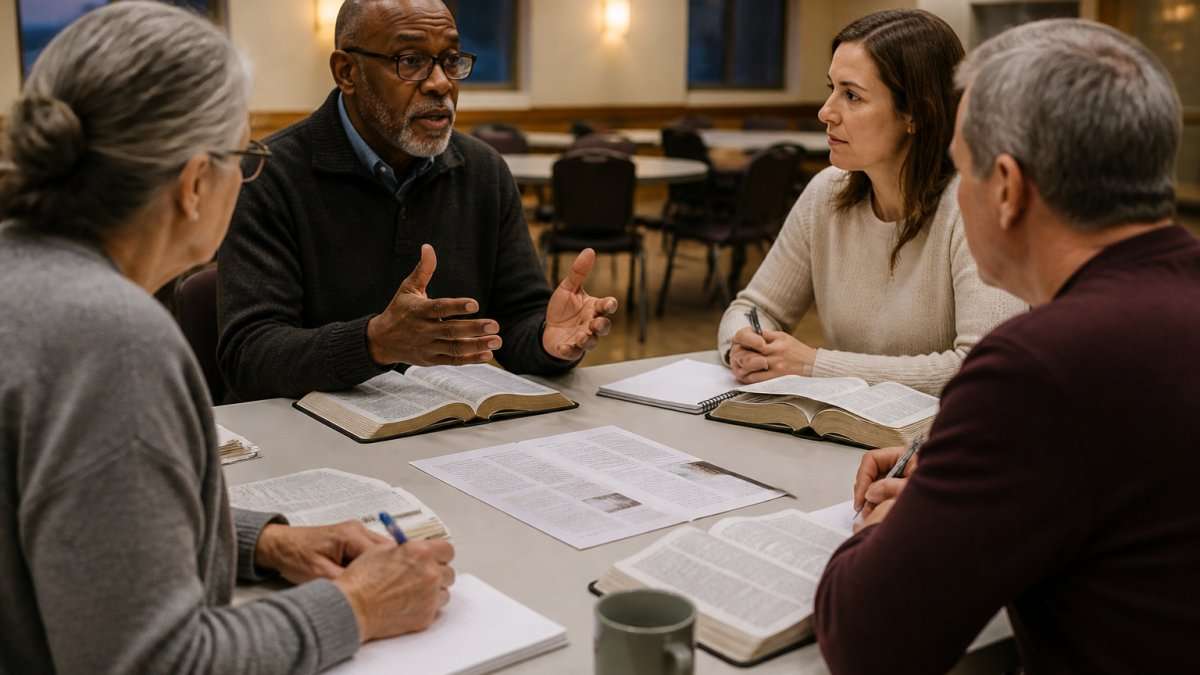
Then set a simple rhythm:
- Before each term: agree the sessions, the teacher for each, and the materials needed.
- Each week: teachers prepare from the lesson plan, not from scratch.
- Each month: leaders meet briefly to review what worked and what fell flat.
Teacher preparation is the difference between a curriculum that runs and one that fades. A short monthly check-in catches problems before volunteers quietly step down.
Adapting One Lesson for a Mixed-Age Room
Small churches rarely have a single age band. A course written for adults will lose teenagers; one written for youth will patronise older members.
A common pattern is a three-tier session plan:
- Shared opening (10 minutes): read the passage aloud and set one question for the whole room.
- Age-banded tasks (15 minutes): younger learners draw or retell the story; teenagers work on a short written response; adults discuss application questions.
- Shared close (10 minutes): each group reports one thing it noticed, and the leader ties it back to the session aim.
This keeps one curriculum, one teacher and one room while giving each group a fitting task, and means you do not need a separate product for every age band, a significant saving for a church of 40.
How to Evaluate Whether It Is Working
Do not wait for a formal review to find out a course is failing. Use four simple measures, collected each term:
- Attendance trend: are the same people coming back, or is the group shrinking week by week?
- Preparation time: are teachers spending the hours the publisher assumes, or double?
- Comprehension: can learners state the main point of last week’s session in one sentence?
- Teacher confidence: would the teacher volunteer to run the same course again?
A course that fails two of these for two terms running is a candidate for revision or replacement. Record the decision and reason so the next leader does not repeat the experiment.
The Keep, Revise or Replace Decision
At the end of each year, sort every course into one of three buckets:
- Keep: attendance is stable, teachers are confident, and the doctrine fits. Renew the licence and reuse the material.
- Revise: the content is sound but the format, pace or age mix is wrong. Adapt the session plan, add tasks, or split the group before spending on a new product.
- Replace: the course clashes with your doctrine, demands more preparation than you have, or cannot be licensed affordably. Replace it at a term boundary, not mid-term.
Do not replace a curriculum in the middle of a term because one session fell flat. Mid-term changes confuse learners and waste the printing you have already paid for. Note the problem, finish the term, and decide at the boundary.
A curriculum is not finished when you buy it. It is finished when your teachers can run it, your learners can explain it, and your leaders have decided to keep it for another year.
For churches wanting to start their own Bible college, partnership programs provide teaching materials and assessment support, help that matters when your leadership team is small.
Frequently Asked Questions
What should a small church look for in a theological curriculum?
Look for four things: doctrinal alignment with your church’s statement of faith, a format your volunteer teachers can actually deliver, a total cost you can sustain year after year, and materials pitched at the right level for your group. A curriculum that is theologically sound but needs a trained lecturer to run it will sit unused in a small church. Ask for sample lessons before committing, and check whether the licence covers the number of groups you plan to run.
What is the difference between a Bible study curriculum and a theology course?
A Bible study curriculum for small groups is usually built around discussion, reflection and application, and is designed for volunteers to lead in a home or church hall. A theology course is more structured and academic, covering doctrine, church history, biblical languages or pastoral ministry, with assessments and a named qualification at the end. Small churches often need both: a study curriculum for the whole congregation and a theology course for leaders who want formal training.
Can a small church create its own theological training programme?
Yes, and many do. The usual route is to partner with a Bible college that supplies teaching materials and assessment support while your church provides the venue, the students and the pastoral oversight. This keeps your doctrinal distinctives intact and lets you train people who would never relocate for residential study. Before starting, confirm what accreditation or recognition the partner offers, how assessment is moderated, and what ongoing support you receive after launch.
How can a church check whether a curriculum aligns with its beliefs?
Read the statement of faith and the table of contents before you read the marketing. Then check the specific chapters where your tradition differs from others: baptism, the work of the Holy Spirit, church governance, and the role of women in ministry. Ask the publisher for a sample teacher’s guide, not just a student workbook, because the leader’s notes reveal the theological assumptions. Run a pilot with two or three trusted leaders and get their honest read before rolling it out.