
Table of Contents
- What to Look for in an Accredited Online Bible College
- Quick Comparison of Top Accredited Online Bible Colleges
- 1. Vision Bible College: Flexible Study at Your Own Pace
- 2. Alphacrucis University College: Accredited Higher Education Pathways
- 3. Australian Lutheran College: Theology Degree Online Australia
- 4. Queensland Theological College: Ministry Training Courses Online
- 5. Sydney College of Divinity: University College Accreditation
- 6. Morling College: Baptist Theological Education Online
Last Updated: August 18, 2026
Choosing an accredited online bible college australia requires understanding which programs hold genuine academic credentials versus those offering certificates without formal recognition. This distinction matters enormously if you’re planning to serve in ministry professionally, pursue further study, or lead a congregation that expects verifiable qualifications.
This guide from Vision Bible College covers the landscape of accredited theological education available online, helping you navigate flexibility, cost, and credibility across seven institutions offering structured pathways from certificates through doctoral degrees.
What to Look for in an Accredited Online Bible College
Understanding Accreditation Standards
In Australia, two main bodies regulate theological education. The Tertiary Education Quality Standards Agency (TEQSA) oversees university colleges and higher education providers. The Australian Skills Quality Authority (ASQA) registers training organisations offering vocational qualifications like Certificate III and IV in Christian Ministry or Theology. An accredited online bible college australia should clearly state which body recognises its awards.
The difference matters practically. TEQSA-registered programs often qualify for government assistance schemes like FEE-HELP, allowing you to defer fees. ASQA-accredited vocational courses may attract Austudy, Abstudy, or Youth Allowance depending on your circumstances. Some institutions, like Vision Bible College, operate across both frameworks, offering ASQA-accredited certificates and vocational diplomas alongside internationally recognised degree pathways.
Non-accredited providers exist too. They’re not necessarily poor quality, but their awards won’t transfer to other institutions, won’t qualify for government funding, and carry less weight in formal employment contexts. If you’re studying purely for personal spiritual growth, that’s acceptable. If you’re building credentials for ministry leadership, accreditation matters.

Check the institution’s website for explicit statements about TEQSA registration or ASQA registration. If they don’t clearly state which body accredits them, contact admissions directly. Reputable providers answer this question immediately.
Flexibility and Study Pace
The best accredited online bible college australia for your situation depends entirely on how much time you can actually commit. Self-paced learning works brilliantly for experienced pastors who’ve already completed formal education and simply need to formalise their theological credentials. It struggles for people coming to biblical studies with no prior formal learning experience, as the lack of external structure causes many to stall. Cohort-based learning provides accountability and peer support but demands you show up on specific days at specific times.
Assess your realistic availability. Most online providers estimate 10-15 hours per week for full-time study equivalent. Part-time stretches that across two to three years. Vision Bible College and similar providers explicitly support part-time progression, letting you adjust your load semester by semester based on ministry demands.
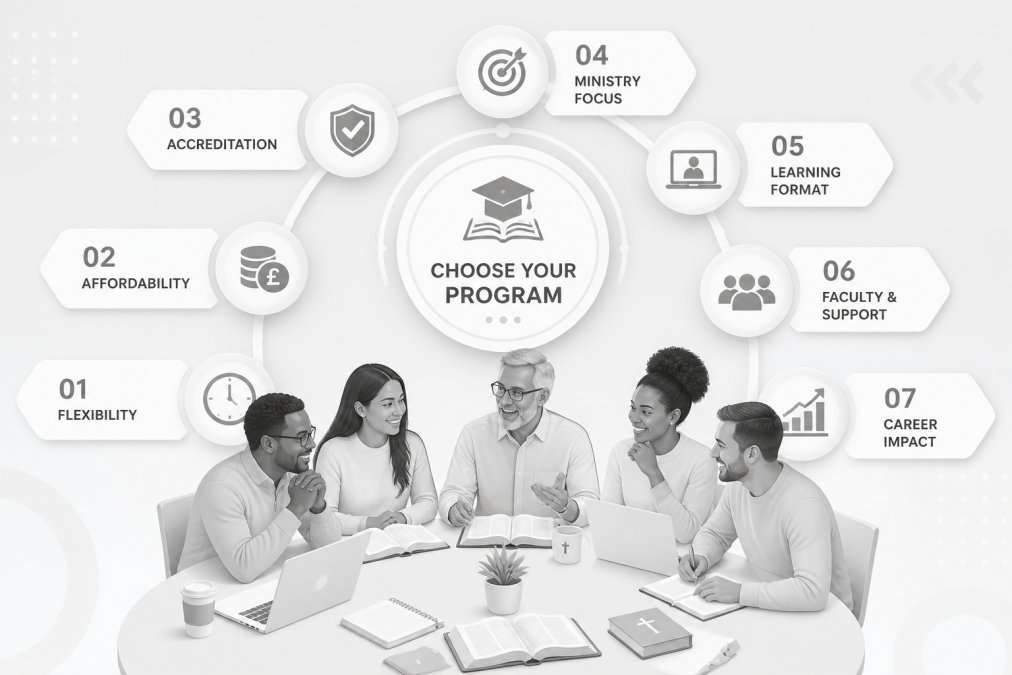
Look for institutions offering both options. The best accredited online bible college australia for you matches your actual life, not your aspirational life.
Starting a degree program and abandoning it halfway damages your ministry credibility more than not starting at all. If you’ve never completed formal study, choose a structured cohort option first. You can always move to self-paced later once you’ve proven you can finish.
Quick Comparison of Top Accredited Online Bible Colleges
| Institution | Accreditation | Study Mode | Key Strength | Best For |
|---|---|---|---|---|
| Vision Bible College | ASQA (vocational), internationally recognised | Fully self-paced | 100+ subjects, church partnership programs | Busy pastors, church planters, flexible scheduling |
| Alphacrucis University College | TEQSA, ASQA | Online + blended | Broad degree range, government funding eligible | Formal higher education pathway |
| Australian Lutheran College | University of Divinity | Online + blended | Lutheran theological tradition | Denominational alignment, teacher training |
| Queensland Theological College | Australian University of Theology | Online + blended | Reformed theology focus | Pastoral ministry emphasis |
| Sydney College of Divinity | TEQSA (self-accrediting) | Online + blended | Consortium model, doctoral options | Advanced theological study |
| Morling College | Australian University of Theology | Online + blended | Baptist affiliation, broad programs | Denominational students, church planting |
| Charis Bible College | International accreditation | Fully self-paced | Offline iPad access, transparent pricing | Charismatic/Pentecostal perspective |
1. Vision Bible College: Flexible Study at Your Own Pace
Vision Bible College stands out for genuinely honouring the "self-paced" promise. You can start any week, study as fast or slowly as your ministry allows, and pause without penalty if a church crisis demands your full attention.
The institution offers over 100 subjects across certificates, diplomas, and degrees, from foundational biblical studies through advanced theological research. ASQA accreditation covers their Certificate III and IV in Christian Ministry, meaning government assistance may apply. Beyond that, Vision Bible College operates internationally recognised study streams (Bachelor through PhD) that transfer globally, which matters if you’re serving cross-culturally or considering international ministry roles.
The church partnership model is genuinely different. Vision Bible College provides complete curriculum, assessment frameworks, and teaching materials to help local churches establish their own Bible colleges. This appeals to church planters and leaders wanting to deepen their congregation’s biblical literacy without sending people elsewhere.
Busy pastors already serving in ministry who need credentials without abandoning their congregation, church planters building discipleship infrastructure, and anyone in geographically isolated areas where other options require relocation.
Most students complete a certificate in 6-12 months, a diploma in 2-3 years, and a degree in 3-5 years depending on study load. Vision Bible College supports part-time progression explicitly, you’re not penalised for taking fewer subjects when ministry demands spike.
The main limitation is that while accreditation covers vocational pathways, the higher degree programs (Bachelor onwards) sit outside formal accreditation frameworks. They’re internationally recognised through established Christian education networks, which works well for ministry but won’t transfer to secular universities if you later pivot careers.
2. Alphacrucis University College: Accredited Higher Education Pathways
Alphacrucis University College operates as a self-accrediting institution under TEQSA, meaning it sets its own academic standards within the regulatory framework. TEQSA accreditation opens government assistance schemes, FEE-HELP lets you defer fees as an income-contingent loan, and Austudy/Abstudy may apply depending on your circumstances.
The college offers certificates, diplomas, bachelor degrees, master’s degrees, and doctorates across theology, ministry, business, education, counselling, and leadership. If you’re seeking formal higher education credentials that transfer to other universities, Alphacrucis delivers that portability.
Online delivery works through a blended model, some components are fully online, others blend online with occasional in-person intensives. The college maintains campuses in multiple locations, so if you need face-to-face support or community, that’s available without requiring relocation.
TEQSA accreditation means your degree sits within the Australian Qualifications Framework (AQF). This matters if you later pursue postgraduate study, change careers, or need formal recognition by government or professional bodies.
The trade-off is that TEQSA institutions operate more formal structures than purely self-paced providers. You’ll work within semester calendars, cohort-based subjects, and standardised assessment timelines.
3. Australian Lutheran College: Theology Degree Online Australia
Australian Lutheran College operates as an accredited college of the University of Divinity, meaning degrees are awarded by the University of Divinity but taught through ALC’s theological framework. This consortium model ensures academic rigour while maintaining Lutheran theological tradition.
The college specialises in theological education for ministry, offering undergraduate and postgraduate awards including diplomas, graduate certificates, graduate diplomas, and master’s degrees. Many courses run fully online, though some components may require occasional in-person attendance.
Teacher training stands out as a specific strength. If you’re leading a church’s educational ministry or training lay teachers, ALC offers pathways specifically designed for that context. FEE-HELP is available for eligible courses, meaning you can defer fees as an income-contingent loan.
4. Queensland Theological College: Ministry Training Courses Online
Queensland Theological College (QTC) operates as an affiliated college of the Australian University of Theology, offering Bachelor of Theology, Master of Divinity, and Graduate Diploma in Theology. Their theological tradition emphasises Reformed theology with strong practical ministry focus.
The college designs specific pathways for different ministry contexts: pastoral ministry, missions, and women’s ministry tracks let you tailor your study to your actual calling. Online and blended options are available, with some courses running fully online and others combining online with intensive in-person blocks (typically a week or two per year).
FEE-HELP and Centrelink allowances apply to eligible courses.
5. Sydney College of Divinity: University College Accreditation
The Australian University College of Divinity operates as a self-accrediting university college under TEQSA. This means it holds independent accrediting authority within the regulatory framework, a significant credential that only a few theological institutions achieve.
The college operates through a federation model where member institutions retain autonomy while participating in a coordinated accreditation structure. Awards range from Diploma in Theology through Doctor of Theology and Doctor of Philosophy. CRICOS registration for international students is available, which matters if you’re serving globally or have international ministry partnerships.
The main appeal is the breadth of theological perspectives available through the consortium model. You’re not locked into a single denominational tradition, the federation includes institutions representing various Christian traditions. For ecumenical ministry contexts or interdenominational leadership, this flexibility matters.
6. Morling College: Baptist Theological Education Online
Morling College offers theological education through affiliation with the Australian University of Theology. In January 2025, Morling merged with Malyon Theological College, significantly expanding its program range and campus network.
The college maintains strong Baptist affiliation while offering programs in theology, ministry, education, counselling, and chaplaincy. Multiple Australian campuses plus online options mean you can choose between campus-based community and fully online study. Baptist theological tradition emphasises congregational governance and believer’s baptism, which shapes the curriculum. The college also emphasises church planting and leadership development.
How to Choose the Right Program for Your Ministry Goals
The accredited online bible college australia you choose should align with three concrete factors: your ministry context, your learning style, and your credential goals.
Ministry context determines whether denominational alignment matters. If you’re serving in a Baptist church, Morling’s Baptist theological tradition directly supports your work. If you’re leading an interdenominational congregation, Sydney College of Divinity’s consortium model offers broader theological perspectives. If you’re planting a church in a rural area, Vision Bible College’s flexibility and church partnership programs might matter more than formal higher education accreditation.
Learning style divides into two camps. Some people thrive with structured cohorts, peer interaction, and external accountability. Others function best with complete scheduling flexibility. Alphacrucis, Queensland Theological College, and Morling offer cohort-based learning with online components. Vision Bible College and Charis Bible College offer fully self-paced options.
Credential goals determine whether TEQSA accreditation matters. If you’re seeking a degree that transfers to other universities, qualifies for government assistance, or carries weight in secular employment contexts, TEQSA-accredited institutions are essential. If you’re formalising credentials for ministry leadership within church contexts, ASQA-accredited vocational qualifications or internationally recognised awards work equally well and often cost less.
Don’t assume that “accredited” means all accreditation is equivalent. TEQSA registration, ASQA registration, and international recognition serve different purposes. Clarify which type of accreditation matters for your specific goal before enrolling.
Comparing Accreditation Frameworks
TEQSA-accredited institutions offer the broadest recognition. Degrees sit within the Australian Qualifications Framework (AQF), transfer between universities, qualify for government assistance schemes, and carry weight in secular employment. They’re the right choice if you might later pursue further study, change careers, or need formal government recognition.
ASQA-accredited vocational qualifications (Certificate III and IV) offer practical training credentials recognised by employers. They’re ideal for people wanting formal recognition of ministry training without committing to a three-year degree. Government assistance may apply depending on your circumstances.
Internationally recognised awards (like those offered by Vision Bible College) transfer globally and carry weight in cross-cultural ministry contexts. They won’t transfer to Australian universities and don’t attract government assistance, but they’re perfectly legitimate for ministry leadership and typically more affordable than formal higher education pathways.
The choice isn’t about one framework being "better", it’s about which recognition serves your actual needs.
Real Considerations Before Enrolling
Time commitment reality-check: Most online providers estimate 10-15 hours weekly for full-time study equivalent. Be brutally honest about whether you actually have that available. Part-time study (6-8 hours weekly) over 5-6 years is more realistic for busy pastors. Choose an institution that explicitly supports part-time progression without penalising you for taking fewer subjects.
Internet reliability: Most online bible college australia programs assume reliable broadband. If you’re in a geographically isolated area with spotty connection, check whether the institution allows offline access. Charis Bible College, for example, offers an iPad-based option with offline lesson access.
Support structure: Online learning works best with genuine human support. Vision Bible College emphasises individual student support, meaning you have a real person to contact when you’re stuck. Ask about tutor availability, response times, and whether you get assigned a specific person.
Withdrawal and refund policies: Before enrolling, understand the institution’s refund policy. Can you pause without losing fees? Can you withdraw and restart later? Reputable institutions have clear policies.
Credit transfer and prior learning recognition: If you’ve already completed theological study elsewhere, ask whether the institution recognises prior learning (RPL) or grants credit transfer. This can shorten your program significantly.
Choosing an accredited online bible college australia ultimately comes down to matching the institution’s strengths to your actual situation. Vision Bible College’s flexibility, affordable tuition, and individual student support serve busy pastors and church planters exceptionally well. Their partnership programs for local church Bible colleges offer something genuinely different. Request an information pack from Vision Bible College to explore how their flexible, self-paced options align with your ministry context and whether their 100+ subjects include the theological depth you’re seeking.
Frequently Asked Questions
How do I verify if an accredited online Bible college is genuinely recognised in Australia?
Check whether the institution is registered with TEQSA (Tertiary Education Quality Standards Agency) for higher education or ASQA (Australian Skills Quality Authority) for vocational training. Many accredited online Bible colleges display their registration status on their websites. You can also verify directly on the TEQSA and ASQA registries. Some colleges operate through consortium models or university colleges that hold self-accrediting authority. Always confirm that the specific program you're interested in carries accreditation, as some colleges offer both accredited and non-accredited pathways.
Can I study for a theology degree online Australia while working full-time in ministry?
Yes, most accredited online Bible colleges offer self-paced study designed specifically for working pastors and ministers. You control when you study, early mornings, evenings, or weekends. Many programs allow you to spread your studies over several years, reducing the weekly time commitment. The key is choosing a provider that emphasises flexibility and individual support. Some colleges, like Vision Bible College, explicitly market their programs to those juggling active ministry roles, offering taster options so you can trial the platform before committing to a full degree.
What's the difference between accredited and non-accredited Bible college programs?
Accredited programs are formally recognised by government bodies (TEQSA or ASQA) and meet established academic standards. These qualifications are widely respected by churches, employers, and other educational institutions, and may qualify for government funding schemes like FEE-HELP or Austudy. Non-accredited programs, sometimes called 'Vision Christian College awards' or internal qualifications, are valuable for personal spiritual growth and church ministry but lack formal government recognition. If you're pursuing ministry professionally or seeking credit transfer to other institutions, accreditation matters significantly. For personal deepening of faith, non-accredited options may suit your needs and budget.
Are online Bible college degrees actually respected by churches and denominations?
Accredited degrees from registered institutions are widely respected. Many churches and denominations recognise qualifications from TEQSA-registered colleges and those affiliated with recognised university colleges like the Australian University of Theology or University of Divinity. Denominational colleges, Baptist, Lutheran, Pentecostal, carry additional weight within their own networks. However, non-accredited certificates or diplomas from smaller providers may not be recognised for formal employment or ordination. If you're pursuing ministry as a career path or seeking ordination, prioritise accredited programs. For lay leadership roles, the institution's reputation within your denomination matters more than formal accreditation.
How long does it take to complete an online theology degree or Bible college diploma?
Timeline varies significantly based on your pace and the qualification level. Certificate programs typically take 1-2 years part-time. Diplomas usually require 2-3 years of part-time study. Bachelor degrees generally span 3-4 years, and master's degrees 2-3 years beyond that. Self-paced programs let you accelerate or slow down depending on your workload. Many working pastors and ministers complete programs over 4-5 years while managing full-time roles. Before enrolling, ask the provider for realistic completion timeframes based on part-time study, and check whether you can pause studies if life circumstances change.
This article was written using GrandRanker